Residential
-dark4.jpg)
-dark4.jpg)
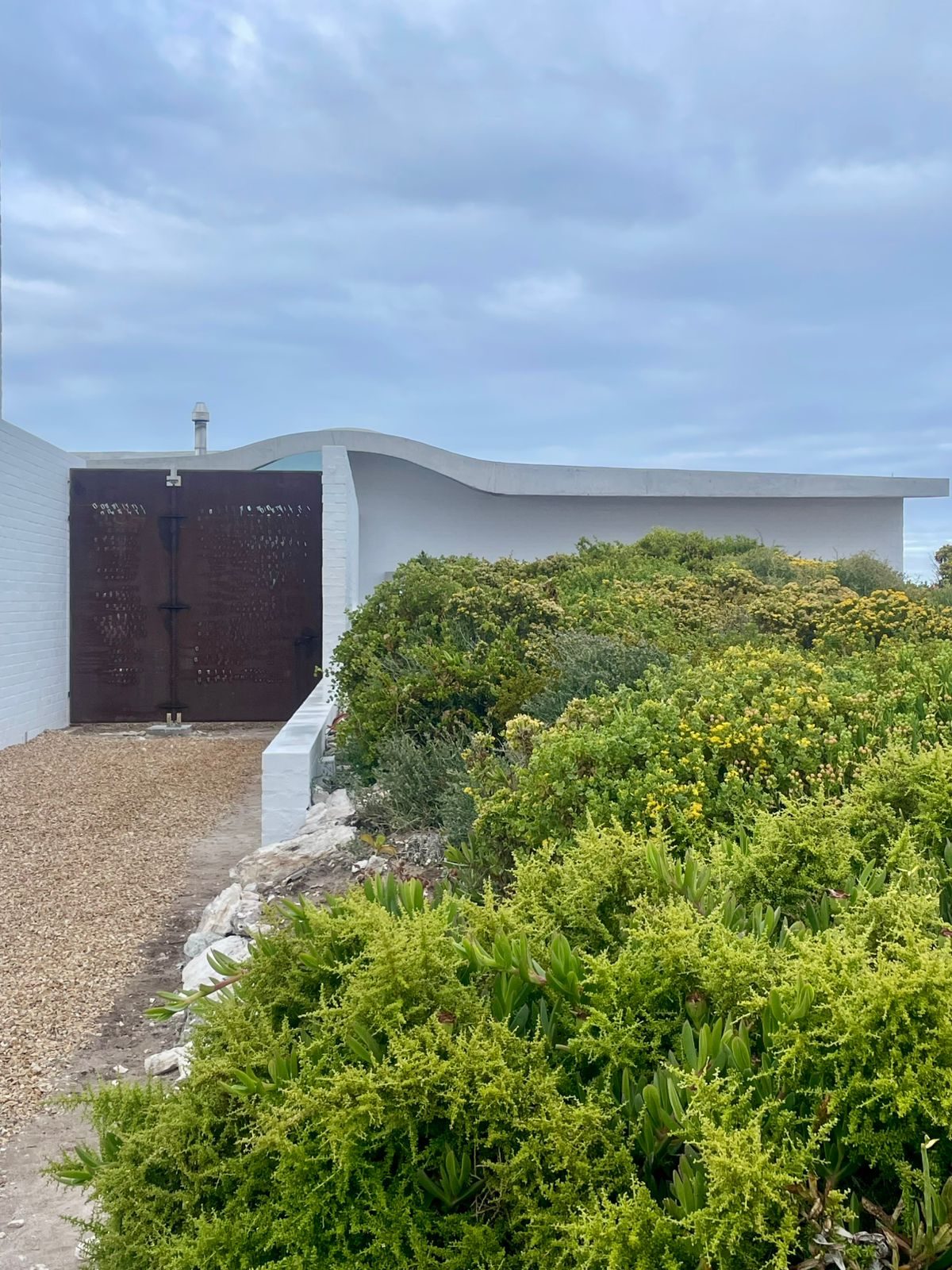
Yzerfontein sits on the West Coast of South Africa, in a landscape classified as Strandveld — a coastal subtype of the Cape Floristic Region, one of the world's six floral kingdoms and a UNESCO World Heritage biome. The Strandveld is not a backdrop. It is dense, salt-tolerant, wind-sculpted scrub that grows right to the building line: Metalasia, Passerina, Chrysanthemoides — low, tough, and tenacious, shaped by the prevailing southerly into forms that hug the ground.
The building is dug approximately 1.2 metres into the site so that it sits below the Strandveld canopy and disappears behind it. From the road, almost nothing is visible. The vault roof — the primary architectural move — reads as a single rounded form rising just above the fynbos line, shaped like the dunes and wind-worn geometry the landscape itself produces. The stoep faces south, looking out over the scrub toward the Atlantic.
The roof is a concrete shell: two flat planes at different gradients, connected by a freeform vaulted surface that floats above the living spaces on a series of tapered columns. The geometry was developed entirely in Rhino and Grasshopper. Early design iterations explored a honeycomb plywood shell — STP files generated for 5-axis CNC cutting — before the decision was made to cast the form in concrete. The computational logic carried forward: the vault's curvature is structurally optimised, not formally arbitrary. The form follows the loads.
The entrance door is 5mm mild steel, laser-cut with a perforation pattern generated in Grasshopper. The pattern is not abstract geometry — it is the Greek word σπίτι (spiti: home). The word is used as a single module: Grasshopper takes the whole word and distributes it across the steel surface at varying scales and rotations, controlling overlap within defined thresholds. The result is a field of the word "home" — dense in places, sparse in others — that filters afternoon light into the entry sequence. The door requires five people to move. The frame is CNC-folded mild steel. The lock is machined in-house.
The door and the vault share the same computational method: a Grasshopper algorithm that generates complex surface behaviour from a simple rule. One does it in concrete over a span. The other does it in steel across a flat plate.
.jpg)
.jpg)
.jpg)
.jpg)
.jpg)
.jpg)
.jpg)
.jpg)
.jpg)
.jpg)
.jpg)
.jpg)
.jpg)
.jpg)
.jpg)
.jpg)
.jpg)
.jpg)
.jpg)
.jpg)
.jpg)
.jpg)
.jpg)
.jpg)
.jpg)
.jpg)
.jpg)
.jpg)
.jpg)